Showing posts with label Biography. Show all posts

5/08/2011

Charlie Chaplin


Charles Spencer Chaplin was born on April 16 at 1889 in Walworth, London. His childhood similar with Charles Dickens novel, because Chaplin live under destitution with his brother, Sydney. His parents are hall musicians. They divorce when Chaplin was vey young. His mother attacked mental disruption illness and her turn into psyche hospital. Although his father is a famous musician, Chaplin’s idol is his mother. When he was young, Chaplin often watches his mother performance. These experiences make him decide his live become an artists like her mother. To reach his goal, Chaplin join with Eight Lancashire Lads group. Then, Chaplin gets his performance at Sherlock Holmes and Casey’s Court Circus.

Meanwhile, his brother, Sydney has joined with famous Fred Karno Company and soon, become main actor and director. He success invite Chaplin to joined and together, Chaplin become a star in that group. For that brothers, Fred Karno Company is a comedian high school. This period have a big impact to Charlie Chaplin to face the future. At 1910, together with Fred Karno Company, Chaplin organize a circumference performance around USA and that it again at 1912.

His second performance in Fred Karno Company, Chaplin founded by seeker talent, Mack Sennett. He is a Keystone Film Company owner. With this company, Charlie Chaplin introduced to movies world. His first film is a Makin A living at 1914, director by Henry Lehrman. Together with his film director, Mabel Normand, Chaplin makes many performances in Keystone Production. At Twenty Minutes of Love movie, he directs his own film. At that moment, he always directs his own next film.

His popularity make him able move to many film company with better contract. At 1915, after creates 35 films, he move to Essanay. Here, he solidifies his career together with long-lasting major artist at his film, such as Edna Purviance. At that moment, he create many protrude film, include The Champion, The Tramp and The Bank.

At 1916, he moves again to Lone Star Mutual and get better contract and higher payment. Here, he create short comedy film and then known as it peculiarity, The Rink, Easy Street, The Cure and The Immigrant, and then continue with First National and create a long film which become his masterpiece, The Kid. He create some short famous comedy film is his next production, included Sunnyside and The Idle Class.

Together with his best friend, like Douglas Fairbanks, Mary Pickford, and D.W Griffith, Chaplin created United Artist at 1919. His first film to this company at 1923 is Woman of Paris performed by Edna Purviance. Maybe this film not too famous, but after this film, The Gold Rush, The Circus, City Light and Modern Times was born and known as Charlie Chaplin Classics. At 1940, Chaplin make his first sound film, The Great Director, and continue with Monsieur Verdoux and Limelight, a his childhood memory in music hall film. Limelight (1952) is a last film in America. McCarthy politic maneuver success extrudes him out of America and not back again until 1972 for obtain Academy Award (Oscar) for his serve to film world.

During that, he welcomed well in England. He live in Switzerland together with his wife, Oona O’Neil and his children. He create 2 more film, A king In New York (1957 together with Dawn Addams) and A Countess From Hong Kong (1967 with Sophia Loren and Marlon Brando). He spend his live with create a music to his film and enjoy live with his family before died at 4 A.M in Christmas 1977.

William Hewlett


If we hear ‘Hewlett’ maybe our imagination is imagine of famous print brand named Hewlett-Packard (HP). It’s true that one of Hewlett Packard founder is William R. Hewlett. Hewlett was born on May, 20 at 1912 in¬¬ Ann Arbor, Mich. At 1939, Hewlett establish Hewlett-Packard (HP) Company together with David Packard who died at 1996.
This company was build only with $538 investment. Of course Hewlett-Packard name taken from their name. In Hewlett-Packard Company, Hewlett hold important commission, but after 1978, Hewlett quit from his commission as Chief Executive Officer.
During his student, Hewlett take some academic title from many colleges. In 1934, Hewlett gain his Bachelor Arts academic title from Stanford University. His master academic in Electrical Engineering, gained from Massachusetts Institute of Technology (MIT) at 1936 and next 3 year, Hewlett gain engineering academic from Stanford University. Hewlett is a receiver of 13 Honorary Degrees in many Universities.
When studied at Stanford University, he meet with David Packard and finally become Hewlett best friend. Hewlett career is interesting. When second word war happen, Hewlett work as US soldier. During his assignment as US soldier, Hewlett included as inspection Japan industries team when second word war over. At 1947, after he back from his assessment, Hewlett go to Palo Ato.
He begin work at his establish company with David Packard and officiate as vice president in Hewlett-Packard company. At 1957, Hewlett officiate as Executive vice president. Seven years later, Hewlett officiate as President of HP. At 1969, he officiate as Chief Executive Officer. Hewlett hold his position during 9 year and at 1978 he quit from his position.
Hewlett is a subjugate person of science and technology. Because of that, at 1985, US president, Ronald Reagan gives him a National Medal of Science appreciation for his service to science and technology. That award is a higher appreciation in America. Hewlett is a education, medical and social big concern person. He work at many institute, like Stanford Medical Center, Kaiser Foundation Hospital, The Carnegie Institution of Washington and Drug Abuse Council in Washington.
William R. Hewlett died at 12 January 2001 when he 87 years, but, Hewlett will always become people memorizes cause his company with David Packard is a one of the best word IT company. Hewlett-Packard creates many gadget like PDA (Personal Digital Assistant), printer, computer, and etcetera. Now, many of Hewlett-Package item, use by all person in the word.

Thomas Alfa Edison


Thomas Alva Edison was born in Milan, Ohio on February 11, 1847. His parents were Samuel and Nancy Edison. Thomas's three older brothers and sisters died before he was born from very harsh winters. He had brother named Pitt and two sisters named Marion and Harriet Ann. His parents named him Thomas because of his great uncle.

When he was young, everyone called him Al. Al asked a lot of questions and was VERY curious. When young Thomas was six, he started a fire in his father's barn and burned it to the ground. He was charged with arson. To show that he was truly sorry, Samuel Edison spanked his son in front of the whole town the next day. Thomas was very embarrassed.

Sam was afraid that his son had no feelings because when Thomas was at the creek, his friend drowned and he showed no emotion. Al's teachers thought that he could not learn and was stupid, and when his teachers told Nancy Edison, she became very mad and decided to teach Thomas herself. Thomas's mother bought him the Dictionary of Science, and he read it all. After that, all of his allowance was spent buying chemicals at the drug store.

Before Thomas Alva Edison was ten, he had already read History of England, Decline and Fall of the Roman Empire, History of the World, and The Age of Reason. When he was eleven, he made his own telegraph set from a picture in a book. Then and there, he decided he wanted to become a telegrapher. At age twelve, he started selling candy on trains to people riding.

When he was 13, he was running behind a train, trying to catch it, when a man snatched his ear and pulled him up onto the train by his ears. Right then, he started to slowly become deaf. Another time, at 15, Thomas saw a boy on a train track, and a train was heading right for him. Al swept by, grabbing the boy, and put him on the grass. The boy's father was so happy, he taught Thomas telegraphy in reward.

When Thomas Edison was 21, he experimented with everything. He was fired from his job at the Boston Telegraph Service because he became bored and started playing jokes on his boss. On May 1, 1869, Thomas received a patent for a vote recording machine, but once it was invented, no one wanted it.
Later, Thomas invented a device that would control errors in stock tickers, and engineers liked it. He wanted at the most, $5,000 for it, but he kept quiet and the engineers offered him $40,000. When Thomas brought his check to the bank, the teller began to yell at him, because he could not hear. He took his check and got out of line. Al went back to the engineer's office and the engineer identified him to the teller, and Thomas had his money, which he spent all on shop equipment.

One day, Thomas Edison saw a lady standing out in the rain, and he fell in love with her. Her name was Mary Stilwell. He offered her a job in his lab, and she accepted. He taught her Morse code, and married her. After the wedding, Thomas went to see the new stock tickers. Mary spent her wedding day alone. The next day, Thomas took Mary to Niagara Falls for their honeymoon and Mary took her sister because she was so upset about Thomas leaving on their wedding day. The telephone was invented a short time later by Alexander Graham Bell. Engineers asked Thomas if he could improve it, and he tried. He invented the first phonograph, and everyone loved it. Mary later had two baby girls: Madeline, and Dot. After his daughters were born, his hard work finally had paid off. He had invented something that would change the world and technology forever.

Thomas Alva Edison had invented the light bulb. He installed a lighting system in New York, and lit it up. Everyone thought that Thomas was a wizard, and gave him the name "Wizard of Menlo Park". After his invention of the light bulb, Mary had two baby boys: Junior and Will. Mary died of Typhoid fever on August 9, 1884. Thomas was sad, but a short time after, he married a young woman named Mina Miller. On their wedding day, he was 38, and she was 22. The next day, they took Thomas's first actual vacation. They went to Paris. Mina had a baby boy named Charles, and a year later, she had another boy, Theodore. After the birth of his sons, he had invented the motion picture. America was so astounded, they named him the American Wizard.

Thomas Alva Edison died a short time later on October 21, 1931 at age 84. He was buried under an oak tree in Glenmont. The United States were so sad, they turned off their power for one minute and prayed throughout the whole United States for a tribute to Thomas Alva Edison.

Louis Pasteur


Louis Pasteur , Master of France chemical and biology, is a very excellence person in medicine history. Pasteur donate many of important idea for science, but the most protrude at himself is a his argue about basil disease theory and preventive technique development by injection.

Pasteur was born in Dole city at 1822, east France. As a Paris student, he deepens his knowledge in science and medicine scope. When he study at France, His genius not really visible, even one of his professor, categorized Pasteur as intermediate person in chemical. After he gain a doctor academic, Pasteur proof that his professor utterance is a big mistake. His research about tartaric acid of glass, make his dignity up to famous chemistry when he 26 years. Then he distract his concern to yarn and proof that that process is same as type of another organism which can produce unwilling yarn water. Soon, this argues lead him to another idea, that organism can produce unpredictable thing and can carry good effect for human or animal.

Pasteur is not the first person who make a problem about basil disease theory. A same hypothesis has been develop earlier by Girolamo Fracastoro, Friedrich Henle and many more. But, Pasteur is the most protrude indeed basil disease theory. Pasteur proof his theory with many of experience and demonstration as a major factor and he success to persuasive cleaver public that this theory is true.
When basil caused disease, prevent bacteria to enter in human body, make the disease can far away from human. Because of that, Pasteur emphasizes the important antiseptic methods for a doctor and he have big influence to Joseph Lister who introduce antiseptic way into surgery scope.

Dangerous bacteria can enter in human body by food and drink. Pasteur develops pasteurization technique to annihilate micro organism in drink. This technique, can annihilate bacteria as infection agent in milk. All of bacteria perish and the milk safe to drink.

When his age approach 50 years old, Pasteur change his concern to cattle basil disease, a kind of serious infection which attack cattle and another animal unexpected human. Pasteur ability to show that kind of basil cause a disease. The most important work is his development technique when product weaker disease basil. With injection a basil to cattle body, the weaker disease basil can caused a light disease but cannot caused anything fatal and probably, the cattle gain an immune to faced normal disease. Pasteur ‘s demonstrate his successes immune cattle from basil in a public caused consternation. Soon, general method can used for prevent various resident disease.

Pasteur in his laboratories
The most famous personal Pasteur discovery is a in a injection technique development for human to prevent scared rabies disease. Like Pasteur, another scientist develop a vaccine to prevent another hard disease like typhus an poliomyelitis.

Pasteur, a workaholic man, create unimportant discovery but still useful for his famous. Pasteur found anaerobic phenomena too, for example one microorganism can live without air or oxygen. Pasteur's works about silk caterpillar, incur a high commercial value. The other discovery is vaccine to prevent cholera disease to chicken and poultry. Pasteur died near Paris 1895. Until now, his discovery still used as basic immune.

Galileo Galilei (1)


Galileo Galilei was born in Pisa, Italy on February 15, 1564. He was the first of 7 children. Although his father was a musician and wool trader, he wanted his clearly talented son to study medicine as there was more money in medicine. So, at age eleven, Galileo was sent off to study in a Jesuit monastery.

After four years, Galileo had decided on his life's work: he announced to his father that he wanted to be a monk. This was not exactly what father had in mind for his gifted son, so Galileo was hastily withdrawn from the monastery. In 1581, at the age of 17, he entered the University of Pisa to study medicine, as his father wished.

Shortly thereafter, at age 20, Galileo noticed a lamp swinging overhead while he was in a cathedral. Curious to find out how long it took the lamp to swing back and forth, he used his pulse to time large and small swings. Galileo discovered something that no one else had ever realized: the period of each swing was exactly the same. The law of the pendulum, which would eventually be used to regulate clocks, made Galileo instantly famous.

Unfortunately, except for mathematics, Galileo was bored by most of his courses and outspoken to his professors. His frequent absences from class eventually led the university to inform Galileo's family that their son was in danger of flunking out. A compromise was worked out, where Galileo would be tutored full-time in mathematics by the mathematician of the Tuscan court. Galileo's father was hardly overjoyed about this turn of events, since a mathematician's earning power was roughly around that of a musician, but it seemed that this might yet allow Galileo to successfully complete his college education. In the end, Galileo left the University of Pisa without a degree--a college dropout.

Faced with the need to somehow earn a living, Galileo started tutoring students in mathematics. He did some experimenting with floating objects, developing a balance that could tell him that a piece of, say, gold was 19.3 times heavier than the same volume of water. He also started campaigning for his life's ambition: a position on the mathematics faculty at a major university. Although Galileo was clearly brilliant, he had offended many people in the field, who would choose other candidates for vacancies. Ironically, it was a lecture on literature that would turn Galileo's fortunes. The Academy of Florence had been arguing over a 100-year-old controversy: What were the location, shape, and dimensions of Dante's Inferno?

To modern ears, this type of question sounds like asking for the location of Sherlock Holmes's 221B Baker Street, or the size of Dr. Frankenstein's castle. But the question was absolutely serious, and Galileo, asked to answer the question from the point of view of a man of science, treated it with dignity. Extrapolating from Dante's line that "[the giant Nimrod's] face was about as long/And just as wide as St. Peter's cone in Rome," Galileo deduced that Lucifer himself was 2,000 armlengths long. The audience was impressed, and Galileo was remembered with favor.

Within the year, Galileo had received a three-year appointment to the University of Pisa, the same university that never granted him a degree!

Isaac Newton (1)


In 1642, the year Galileo died, England on Christmas Day. His father had died three months earlier, and baby Isaac, very premature, was also not expected to survive. It was said he could be fitted into a quart pot. When Isaac was three, his mother married a wealthy elderly clergyman from the next village, and went to live there, leaving Isaac behind with his grandmother. The clergyman died, and Isaac’s mother came back, after eight years, bringing with her three small children. Two years later, Newton went away to the Grammar School in Grantham, where he lodged with the local apothecary, and was fascinated by the chemicals. The plan was that at age seventeen he would come home and look after the farm. He turned out to be a total failure as a farmer.

His mother’s brother, a clergyman who had been an undergraduate at Cambridge, persuaded his mother that it would be better for Isaac to go to university, so in 1661 he went up to Trinity College, Cambridge. Isaac paid his way through college for the first three years by waiting tables and cleaning rooms for the fellows (faculty) and the wealthier students. In 1664, he was elected a scholar, guaranteeing four years of financial support. Unfortunately, at that time the plague was spreading across Europe, and reached Cambridge in the summer of 1665. The university closed, and Newton returned home, where he spent two years concentrating on problems in mathematics and physics. He wrote later that during this time he first understood the theory of gravitation, which we shall discuss below, and the theory of optics (he was the first to realize that white light is made up of the colors of the rainbow), and much mathematics, both integral and differential calculus and infinite series. However, he was always reluctant to publish anything, at least until it appeared someone else might get credit for what he had found earlier.

On returning to Cambridge in 1667, he began to work on alchemy, but then in 1668 Nicolas Mercator published a book containing some methods for dealing with infinite series. Newton immediately wrote a treatise, De Analysi, expounding his own wider ranging results. His friend and mentor Isaac Barrow communicated these discoveries to a London mathematician, but only after some weeks would Newton allow his name to be given. This brought his work to the attention of the mathematics community for the first time. Shortly afterwards, Barrow resigned his Lucasian Professorship (which had been established only in 1663, with Barrow the first incumbent) at Cambridge so that Newton could have the Chair.

Newton’s first major public scientific achievement was the invention, design and construction of a reflecting telescope. He ground the mirror, built the tube, and even made his own tools for the job. This was a real advance in telescope technology, and ensured his election to membership in the Royal Society. The mirror gave a sharper image than was possible with a large lens because a lens focusses different colors at slightly different distances, an effect called chromatic aberration. This problem is minimized nowadays by using compound lenses, two lenses of different kinds of glass stuck together, that err in opposite directions, and thus tend to cancel each other’s shortcomings, but mirrors are still used in large telescopes.

Later in the 1670’s, Newton became very interested in theology. He studied Hebrew scholarship and ancient and modern theologians at great length, and became convinced that Christianity had departed from the original teachings of Christ. He felt unable to accept the current beliefs of the Church of England, which was unfortunate because he was required as a Fellow of Trinity College to take holy orders. Happily, the Church of England was more flexible than Galileo had found the Catholic Church in these matters, and King Charles II issued a royal decree excusing Newton from the necessity of taking holy orders! Actually, to prevent this being a wide precedent, the decree specified that, in perpetuity, the Lucasian professor need not take holy orders. (The current Lucasian professor is Stephen Hawking.)

James Watt (1)


James watt is from Scotland he invent steam engine, the key to industrial revolution.
Actually, watt is not the first person that made steam engine, same scheme also made by hero from iskandarya in early cristian's years. In 1682 thomase savery made his paten to his water pump machine and in 1712 english man thomas newcomen also made his same paten that more perfect but still newcomen machine is less eficient and low quality because only can use to waterpump for coal mine.
Watt became intersting in steam engine in 1764 when he fixed newcomen machine, even he only have one year study in tools but he had big talent to create something big, he made more perfect to newcomen machine, because the perfection of watt is more important so deserve to became the first person who made practically steam engine.

12/18/2010

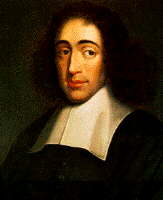
Baruch Spinoza (1632-1677)

Spinoza

Baruch Spinoza was born to Portuguese Jews living in exile in Holland, but his life among the Marranos there was often unsettled. Despite an early rabbinical education, he was expelled from the synagogue at Amsterdam for defending heretical opinions in 1656. While engaging privately in serious study of medieval Jewish thought, Cartesian philosophy, and the new science at Rijnburg and the Hague, Spinoza supported himself by grinding optical lenses, an occupation that probably contributed to the consumption that killed him. Private circulation of his philosophical treatises soon earned him a significant reputation throughout Europe, but Spinoza so treasured his intellectual independence that in 1673 he declined the opportunity to teach at Heidelberg, preferring to continue his endeavors alone.

    Spinoza's first published work was a systematic presentation of the philosophy of Descartes, to which he added his own suggestions for its improvement. The Principles of Descartes's Philosophy (1663) contain many of the characteristic elements of his later work, but Spinoza seems to have realized that a full exposition of his own philosophical views would require many years of devoted reflection. In the meantime, he turned his attention briefly to other issues of personal and social importance. The Tractatus Theologico-Politicus (A Theologico-Political Treatise) (1670) is an examination of superficial popular religion and a vigorous critique of the miltant Protestantism practiced by Holland's ruling House of Orange. Spinoza disavowed anthropomorphic conceptions of god as both logically and theologically unsound, proposed modern historical-critical methods for biblical interpretation, and defended political toleration of alternative religious practices. Christians and Jews, he argued, could live peaceably together provided that they rose above the petty theological and cultural controversies that divided them.

Although he published nothing else during his lifetime, metaphysical speculations continued to dominate Spinoza's philosophical reflections, and he struggled to find an appropriate way to present his rationalistic conviction that the universe is a unitary whole. Bust of Spinoza Respect for deductive reasoning and for the precision of the Latin language led Spinoza to express his philosophy in a geometrical form patterned on that empolyed in Euclid's Elements. Thus, each of the five books of Spinoza's Ethica Ordine Geometrico Demonstrata (Ethics) (1677) comprises a sequence of significant propositions, each of which is deduced from those that have come before, leading back to a small set of self-evident definitions and axioms.

In Book I Spinoza claimed to demonstrate both the necessary existence and the unitary nature of the unique, single substance that comprises all of reality. Spinoza preferred the designation "Deus sive Natura" ("god or nature") as the most fitting name for this being, and he argued that the its infinite attributes account for every feature of the universe. Book II describes the absolute necessity with which the two attributes best known to us, thought and extension, unfold in the parallel structure that we, with our dual natures, comprehend as the ideas and things with which we are acquainted in ordinary life. This account also provides for the possibility of genuine human knowledge, which must be based ultimately on the coordination of these diverse realms. Spinoza's Tractatus de Intellectus Emendatione (On the Improvement of the Understanding) (1677) provides additional guidance on the epistemological consequences of his metaphysical convictions. Here Spinoza proposed a "practical" method for achieving the best knowledge of which human thinkers are capable.

Spinoza applied similar principles to human desires and agency in Books III-V of the Ethics, recommending a way of life that acknowledges and appropriates the fundamental consequences of our position in the world as mere modes of the one true being. It would be moral bondage if we were motivated only by causes of which we remain unaware, Spinoza held, so genuine freedom comes only with knowledge of what it is that necessitates our actions. Recognizing the invariable influence of desire over our passionate natures, we then strive for the peace of mind that comes through an impartial attachment to reason. Although such an attitude is not easy to maintain, Spinoza concluded that "All noble things are as difficult as they are rare."

12/16/2010

habit ibn Qurra Biography

Thabit ibn Qurra abu' l'Hasan ibn Marwan al-Sabi al'Harrani, (826 – February 18, 901) was an Arab astronomer and mathematician. In Latin he was known as Thebit.Thabit was born in Harran (antique Carrhae), Mesopotamia (now Turkey). Upon the proposal of Muhammad ibn Musa ibn Shakir Thabit went to study in Baghdad to Shakir's brothers the Bani Mussa. He led a group of translators, who came from the pagan pseudo Sabeans from Harran.

Arabic writters confound the Babylonian Sabeans from the Harrarian Sabeans. Harrarian Sabeans respected stars and for this reason they have very soon showed a great interests for astronomy and mathematics. In the times of Muslim supremacy they have accepted the name Sabean to get benefits from privileges that were allowed by the Ko'ran. This name later ramained and this strange sect have lived in vicinity of the main center of the Caliphate till the half of the 13th century, when the Mongols have destroyed their last shrine. Their merits in the spiritual and scientifical fields have with no doubt helped them to get a protection from the Muslims. In the times of al-Mutawakkil reign their city became a center of the philosophical and medical school, which was transferred from Alexandria to Antioch. Very soon they have taken over a huge part of the Greek culture and science. In the beginnings they have spoken Greek.

Thabit and his pupils lived in this midst. He worked in Baghdad and he occupied himself with mathematics, astronomy, mechanics, medicine and philosophy. His native language was Syriac, which was the eastern Aramaic dialect from Edessa, and he knew well also Greek. He translated from Greek Apollonius, Archimedes, Euclid and Ptolemy. Thabit had revised translation of Euclid Elements of Hunayn ibn Ishaq. He had also rewritten the Hunayn's translation of Ptolemy's Almagest and he translated Ptolemy's Geography, which later became very known. Later Thabit's patron was the Abbasid Caliph al-Mu'tadid (reigned 892–902) and Thabit very soon became his personal friend and the visitor of his court. There are just a few original Thabit's works that were preserved.

Thabit has developed a theory about the trepidation and oscilation of the equinoctial points, of which many scolars debated in the Middle Ages. According to Copernicus Thabit has determined the length of the sidereal year 365d 6h 9m 12s (an error of 2s). He published his observations of the Sun. In mathematics Thabit discovered an equation for determining the amicable numbers.

Thabit died in Baghdad. After him the greatest Sabean name was Al-Batani. Thabit and his grandson Ibrahim ibn Sinan have studied the curves which are needed for making of sundials. Abu'l-Wafa has also written a book about the geometrical methods, which were required by
craftsmen.

12/15/2010

Ibn Battuta (1304 - 1377)

Ibn Battuta
Abu Abdullah Muhammad Ibn Battuta (February 24, 1304 - 1377) was a Moroccan Berber traveller and explorer. His name is also sometimes spelled ibn Batuta.At the instigation of the Sultan of Morocco, Ibn Battuta dictated an account of his journeys to a scholar named Ibn Juzayy, whom he had met while in Iberia. While obviously fictional in places, the Rihla (translated somewhat inaccurately into English as "My Travels") still gives as complete an account as exists of some parts of the world in the 14th century.

Almost all that is known about Ibn Battuta's life comes from one source -- Ibn Battuta himself. In spots the things he claims he saw or did are probably fanciful, but in many thers there is no way to know whether he is reporting or story-telling. The following account assumes the former where it is not obviously the latter.

Born in Tangier, Morocco some time between 1304 and 1307, at the age of (approximately) twenty Ibn Battuta went on a hajj -- a pilgrimage to Mecca. Once done, however, he continued travelling, eventually covering about 75,000 miles over the length and breadth of he Muslim world.

His journey to Mecca was by land, and followed the North African coast quite closely until he reached Cairo. At this point he was within Mameluk territory, which was relatively safe, and he embarked on the first of his detours. Three commonly used routes existed to Mecca, and Ibn Battuta chose the least-travelled: a journey up the Nile, then east by land to the Red Sea port of 'Aydhad. However, upon approaching that city he was forced to turn back due to a local rebellion.

Returning to Cairo he took a second side trip, to Damascus (then also controlled by the Mameluks), having encountered a holy man during his first trip who prophesied that Ibn Battuta would only reach Mecca after a journey through Syria. An additional advantage to the side journey was that other holy places were along the route -- Hebron, Jerusalem, and Bethlehem, for example -- and the Mameluke authorities put special effort into keeping the journey safe for pilgrims.

After spending Ramadan in Damascus, Ibn Battuta joined up with a caravan travelling the 800 miles from Damascus to Medina, burial place of Mohammed. After four days, he then journeyed on to Mecca. There he completed the usual rituals of a Muslim pilgrim, and having graduated to the status of al-Hajji as a result, now faced his return home. Upon reflection, he decided to continue journeying instead. His next destination was the Il-Khanate in modern-day Iraq and Iran.

Once again hooking up with a caravan he crossed the border into Mesopotamia and visited al-Najaf, the burial place of the fourth Caliph Ali. From there he journeyed to Basra, then Isfahan, which was only a few decades away from being nearly destroyed by Timur. Next were Shiraz and Baghdad, the latter of which was in bad shape after being sacked by Hulagu Khan. There he met Abu Sa'id, the last ruler of the unified Il-Khanate. Ibn Battuta travelled with the royal caravan for a while, then turned north to Tabriz on the Silk Road. The first major city in the region to open its gates to the Mongols, it had become an important trading centre after most of its nearby rivals were razed.

After this trip, Ibn Battuta returned to Mecca for a second hajj, and lived there for a year before embarking on a second great trek, this time down the Red Sea and the East African coast. His first major stop was Aden, where his intention was to make his fortune as a trader of the goods that flowed into the Arabian Peninsula from around the Indian Ocean. Before doing so, however, he determined to have one last adventure, and signed on for a trip down the coast of Africa.

Spending about a week in each of his destinations, he visited Ethiopia, Mogadishu, Mombasa, Zanzibar, and Kilwa, among others. With the change of the monsoon, he and the ship he was aboard then returned to south Arabia. Having completed his final adventure before settling down, he then immediately decided to go visit Oman and the Straits of Hormuz. This done, he journeyed to Mecca again.

Spending another year there, he then resolved to seek employment with the Muslim sultan of Delhi. Needing a guide and translator if he was to travel there, he went to Anatolia, then under the control of the Seljuk Turks, to join up with one of the caravans that went from there to India. A sea voyage from Damascus on a Genoese ship landed him in Alanya on the southern coast of modern-day Turkey. From there he travelled by land to Konya and then Sinope on the Black Sea coast. Crossing the Black Sea, Ibn Battuta landed in Kaffa, in the Crimea, and entered the lands of the Golden Horde. There he bought a wagon and fortuitously joined the caravan of Ozbeg, the Golden Horde's Khan, on a journey as far as Astrakhan on the Volga River.

Upon reaching Astrakhan, the Khan allowed one of his pregnant wives to go give birth back in her home city -- Constantinople. It is perhaps of no surprise to the reader that Ibn Battuta talked his way into this expedition, his first beyond the boundaries of the Islamic world.

Arriving there towards the end of 1332, he met the emperor Andronicus III and saw the outside of Hagia Sophia. After a month in the city, he retraced his route to Astrakhan, then carried on past the Caspian and Aral Seas to Bokhara and Samarkand. From there he journeyed south to Afghanistan, the mountain passes of which he used to cross into India.

The Sultanate of Delhi was a relatively new addition to Dar al-Islam, and the sultan had resolved to import as many Muslim scholars and other functionaries as possible to consolidate his rule. On the strength of his years of studies while in Mecca, Ibn Battuta was employed as a qadi ("judge") by the Sultan Muhammed Tuguluq. The Sultan was erratic even by the standards of the time, and Ibn Battuta veered between living the high life of a trusted subordinate, and being under suspicion for a variety of reasons. Eventually he resolved to leave on the pretext of taking another hajj, but the Sultan offered the alternative of being ambassador to China. Given the opportunity to both get away from the Sultan and visit new lands, Ibn Battuta took it.

En route to the coast, he and his party were attacked by Hindu rebels, and separated from the others he was robbed and nearly lost his life. Nevertheless, he managed to catch up with his group within two days, and continued the journey to Cambay. From there they sailed to Calicut. While Ibn Battuta visited a mosque on shore, however, a storm blew up and two of the ships of his expedition were sunk. The third then sailed away without him, and ended up seized by a local king in Sumatra a few months later.

Fearful of returning to Delhi as a failure, he stayed for a time in the south under the protection of Jamal al-Din, but when that worthy was overthrown it became necessary for Ibn Battuta to leave India altogether. He resolved to carry on to China, with a detour near the beginning of the journey to the Maldives. In the Maldives he spent nine months, much more time than he had intended to. As a qadi his skills were highly desirable in the backwards islands and he was half-bribed, half-kidnapped into staying. Appointed chief judge and marrying into the royal family, he became embroiled in local politics, and ended up leaving after wearing out his welcome by imposing strict judgments in the laissez-faire island kingdom. From there he carried on to Ceylon for a visit to Adam's Peak.

Setting sail from Ceylon, his ship nearly sank in a storm, then the ship that rescued him was attacked by pirates. Stranded on shore, Ibn Battuta once again worked his way back to Calicut, from where he then sailed to the Maldives again before getting onboard a Chinese junk and trying once again to get to China.

This time he succeeded, reaching in quick succession Chittagong, Sumatra, Vietnam, and then finally Quanzhou in Fujian Province, China. From there he went north to Hangzhou, not far from modern-day Shanghai. He also claimed to have travelled even further north, through the Grand Canal to Beijing, but this is believed to be one of his tales, not an actual event. Returning to Quanzhou, Ibn Battuta decided to return home -- though exactly where "home" was a bit of a problem. Returning to Calicut once again, he pondered throwing himself on the mercy of Muhammed Tuguluq, but thought better of it and decided to carry on to Mecca once again. Returning via Hormuz and the Il-Khanate, he saw that state dissolved into civil war, Abu Sa'id having died since his previous trip there.

Returning to Damascus with the intention of retracing the route of his first hajj, he learned that his father had died. Death was the theme of the next year or so, for the Black Death had begun, and Ibn Battuta was on hand as it spread through Syria, Palestine, and Arabia. After reaching Mecca, he decided to return to Morocco, nearly a quarter century after leaving it. During the trip he made one last detour to Sardinia, then returned to Tangier to discover that his mother had also died, a few months before.

Having settled in Tangier for all of a few days, Ibn Battuta then set out for a trip to al-Andalus -- Muslim Spain. Alfonso XI of Castile was threatening the conquest of Gibraltar, and Ibn Battuta joined up with a group of Muslims leaving Tangier with the intention of defending the port. By the time he arrived the Black Death had killed Alfonso and the threat had receded, so Ibn Battuta decided to visit for pleasure instead. He travelled through Valencia, and ended up in Granada.

Leaving Spain he decided to travel through one of the few parts of the Muslim world that he had never explored: Morocco. On his return home he stopped for a while in Marrakesh, which was nearly a ghost town after the recent plague and the transfer of the capital to Fez.

Biography

Once more he returned to Tangier, and once more he moved on. Two years before his own first visit to Cairo, the Malian king Mansa Musa had passed through the same city on his own hajj and had caused a sensation with his extravagant riches -- something like half the world's gold supply at the time was coming from West Africa. While Ibn Battuta never mentions this specifically, hearing of this during his own trip must have planted a seed in his mind, for he decided to set out and visit the Muslim kingdom on the far side of the Sahara Desert.

In the fall of 1351, Ibn Battuta set out from Fez, reaching the last Moroccan town (Sijilmasa) a bit more than a week later. When the winter caravans began a few months later, he was with one, and within a month he was in the Central Saharan town of Taghaza. A centre of the salt trade, Taghaza was awash with salt and Malian gold, though Ibn Battuta did not have a favorable impression of the place. Another 500 miles through the worst part of the desert brought him to Mali, particularly the town of Walata.

From there he travelled southwest along a river he believed to be the Nile (but that was, in actuality, the Niger River) until he reached the capital of the Mali Empire. There he met Mansa Sulayman, king since 1341. Dubious about the miserly hospitality of the king, he nevertheless stayed for eight months before journeying back up the Niger to Timbuktu. Though in the next two centuries it would become the most important city in the region, at the time it was small and unimpressive, and Ibn Battuta soon moved on. Partway through his journey back across the desert, he received a message from the Sultan of Morocco, commanding him to return home. This he did, and this time it lasted.

After the publication of the Rihla, little is known about Ibn Battuta's life. He may have been appointed a qadi in Morocco. Ibn Battuta died in Morocco some time between 1368 and 1377. For centuries his book was obscure, even within the Muslim world, but in the 1800s it was rediscovered and translated into several European languages. Since then Ibn Battuta has grown in fame, and is now a well-known figure in the Middle East.

Galileo Galilei (564 - 1642)


Galileo Galilei (February 15, 1564 - January 8, 1642), was a Tuscan astronomer, philosopher, and physicist who is closely associated with the Scientific Revolution. Galileo was born in Pisa and his career coincided with that of Kepler. The work of Galileo is considered to be a significant break from that of Aristotle; in particular, Galileo placed emphasis on quantity, rather than quality.

Experimental science
In the pantheon of the scientific revolution Galileo occupies a high position because of his pioneering use of quantitative experiments with results analyzed mathematically. There was no tradition of such methods in European thought at that time; the great experimentalist who immediately preceded Galileo, William Gilbert, did not use a quantitative approach. In the 20th century the reality of Galileo's experiments was challenged by some authorities, in particular the distinguished French historian of science Alexandre Koyré. The experiments on falling bodies (actually rolling balls) were replicated using the methods described by Galileo (Settle, 1961), and the precision of the results was consistent with Galileo's report. Later research into Galileo's unpublished working papers from as early as 1604 clearly showed the reality of the experiments and even indicated the particular results that led to the time-squared law (Drake, 1973).

Astronomy
Galileo was one of the first people to use the telescope to observe the sky. Galileo Galilei's discovery of the moons of Jupiter. For a translation from Sidereus Nuncius click on the picture.On January 7th 1610 Galileo discovered Jupiter's four largest satellites (moons): Io, Europa, Ganymede, and Callisto. (Later astronomers overruled Galileo's naming of these objects, changing his Medicean stars to Galilean satellites.) Galileo noted that Venus exhibited a full set of phases like the Moon. Because the apparent brightness of Venus is nearly constant, Galileo reasoned that Venus could not be circling the Earth at a constant distance. Galileo was one of the first Europeans to observe sunspots, although there is evidence that Chinese astronomers had done so before. Physics

Galileo's theoretical and experimental work on the motions of bodies, along with the largely independent work of Kepler and Descartes, was a precursor of the Classical mechanics developed by Sir Isaac Newton. Galileo also noted that a pendulum's swings always take the same amount of time, independently of the amplitude. While Galileo believed this equality of period to be exact, it is only approximate, applying to small swings. In the early 1600s, Galileo and an assistant tried to measure the speed of light. At a distance of less than a mile, Galileo could detect no delay in the round-trip time greater than when he and the assistant were only a few yards apart. While Galileo's application of mathematics to experimental physics was innovative, his mathematical methods were the standard ones of the day. Galileo produced one piece of original and even prophetic work in mathematics: Galileo's paradox, which shows that there are as many perfect squares as there are whole numbers, even though most numbers are not perfect squares. 

Galileo made a few contributions to what we now call technology as distinct from pure physics, and suggested others. In 1595 - 1598 Galileo devised and improved a "Geometric and Military Compass" suitable for use by gunners and surveyors. Church controversy

Galileo was a devout Catholic, yet his writings on Copernican heliocentrism disturbed some in the Catholic Church, who believed in a geocentric model of the solar system. For his insights, Galileo was threatened with death at the stake and would eventually face lifelong house arrest after recanting his claims.

The geocentric model was generally accepted at the time for several reasons. By the time of the controversy, the Catholic Church had largely abandoned the Ptolemaic model for the Tychonian model in which the Earth was at the centre of the Universe, the Sun revolved around the Earth and the other planets revolved around the Sun. The first to defend Galileo was a Benedictine abbot, Benedetto Castelli, who was also a professor of mathematics and a former student of Galileo's. It was this exchange that led Galileo to write the Letter to Grand Duchess Christina. (Castelli remained Galileo's friend, visiting him at Arcetri near the end of Galileo's life, after months of effort to get permission from the Inquisition to do so.)

However, real power lay with the Church, and Galileo's arguments were most fiercely fought on the religious level. The Church authorities gave Caccini promotion. Father Lorini proved that Galileo's doctrine was not only heretical but "atheistic," and besought the Inquisition to intervene. The Bishop of Fiesole screamed in rage against the Copernican system, publicly insulted Galileo, and denounced him to the Grand-Duke. The Archbishop of Pisa secretly sought to entrap Galileo and deliver him to the Inquisition at Rome. (White, 1898; online text (http://www.santafe.edu/~shalizi/White/astronomy/war.html))

When Galileo was tried in 1633, the Inquisition was proceeding on the premise that he had been ordered not to teach it at all, based on a paper in the records from 1616; but Galileo produced a letter from Cardinal Bellarmine that showed only the "hold or defend" order. The Roman Inquisition had rejected earlier pleas by Galileo to postpone or relocate the trial because of his ill health. Galileo arrived in Rome for his trial before the Inquisition on February 13, 1633. On April 12, 1633, Galileo was brought to trial, and the formal interrogation by the Inquisition began. During this interrogation Galileo stated that he did not defend the Copernican theory, and cited a letter of Cardinal Bellarmine from 1615 to support this contention. In a second hearing on April 30, Galileo confessed to having erred in the writing of the book, through vain ambition, ignorance, and inadvertence. He was then allowed to return to the home of the Tuscan ambassador. On June 22, 1633, the Inquisition held the final hearing on Galileo, who was then 69 years old and pleaded for mercy, pointing to his "regrettable state of physical unwellness". The tale that Galileo, rising from his knees after recanting, said "Eppur si muove!" A Spanish painting, dated 1643 or possibly 1645, shows Galileo writing the phrase on the wall of a dungeon cell. Here we have a second version of the story, which also cannot be true, because Galileo was never imprisoned in a dungeon; but the painting shows that some story of "Eppur si muove" was circulating in Galileo's time. Galileo was sentenced to prison, but because of his advanced age (and/or Church politics) the sentence was commuted to house arrest at his villas in Arcetri and Florence[1] (http://www.lucidcafe.com/library/96feb/galileo.html). Though the sentence announced against Galileo mentioned no other works, Galileo found out two years later that publication of anything he might ever write had been quietly banned. Moreover, deeper examination of the primary sources for Galileo and his trial shows that claims of torture and deprivation were likely exaggerated. Dava Sobel's Galileo's Daughter offers a different set of insights into Galileo and his world, in large part through the private correspondence of Maria Celeste, the daughter of the title, and her father.

In 1992, 359 years after the Galileo trial, Pope John Paul II issued an apology, lifting the edict of Inquisition against Galileo: "Galileo sensed in his scientific research the presence of the Creator who, stirring in the depths of his spirit, stimulated him, anticipating and assisting his intuitions."

12/13/2010

Hans Georg Gadamer

Hans Georg Gadamer (February 11, 1900 - March 13, 2002) was a German philosopher best known for his 1960 magnum opus, Truth and Method (Wahrheit und Methode), in which his central project was to uncover the nature of human understanding. Gadamer was critical of the pervasiveness of methodological thinking in the humanities, arguing instead for the employment of "philosophical hermeneutics" as the key to revealing truth in the human sciences (Geisteswissenschaften). He was influenced greatly by and Martin Heidegger (with whom he studied). Gadamer is also noted for his debates with fellow philosophers Jacques Derrida and Jürgen Habermas, whom he secured his first professorship in Heidelberg. Gadamer was born in Marburg, Germany, as the son of a famous professor of pharmaceutical chemistry and died in Heidelberg, Germany.

Quotes
Nothing exists except through language.
I basically only read books that are over 2,000 years old.
In fact history does not belong to us; but we belong to it. Long before we understand ourselves through the process of self-examination, we understand ourselves in a self-evident way in the family, society and state in which we live. The focus of subjectivity is a distorting mirror. The self-awareness of the individual is only a flickering in the closed circuits of historical life. That is why the predjudices [pre-judgements (Vorurteil)] of the individual, far more than his judgements, constitute the historical reality of his being. (Gadamer 1989:276-7, tr.)

The more language is a living operation, the less we are aware of it. Thus it follows from the self-forgetfulness of language that its real being consists in what is said in it. What is said in it constitutes the common world in which we live and to which the whole great chain of tradition reaching us from the literature of foreign languages, living as well as dead. The real being of language is that into which we are taken up when we hear it -- what is said. (Gadamer 1976:65, tr.)

12/10/2010

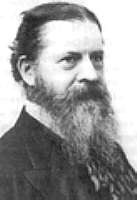
Charles Sanders Peirce (1839-1914)

Peirce

Charles Sanders Peirce studied philosophy and chemistry at Harvard, where his father, Benjamin Peirce, was professor of mathematics and astronomy. Although he showed early signs of great genius, an unstable personal life prevented Peirce from fulfilling his early promise. He wrote widely and delivered several series of significant lectures, but never completed the most ambitious of his philosophical projects. After a respectable scientific career studying the effects of gravitation with the U.S. Coast and Geodetic Survey, Peirce taught logic and philosophy for five years at Johns Hopkins University. In 1887, however, he retired to a life of isolation, poverty, and illness in Milford, Pennsylvania. Peirce     Peirce's early philosophical development relied on a Kantian theory of judgment, but careful study of the logic of relations led him to abandon syllogistic methods in favor of the study of language and belief. His place as the founder of American pragmatism was secured by a pair of highly original essays that apply logical and scientific principles to philosophical method. In The Fixation of Belief (1877) Peirce described how human beings converge upon a true opinion, each of us removing the irritation of doubt by forming beliefs from which successful habits of action may be derived. This theory was extended in How to Make Our Ideas Clear (1878) to the very meaning of concepts, which Peirce identified with the practical effects that would follow from our adoption of them. Peirce     In his extensive logical studies, Peirce developed a theory of signification that anticipated many features of modern semiotics, emphasizing the role of the interpreting subject. To the traditional logic of deduction and induction, Peirce added explicit acknowledgement of abduction as a preliminary stage in productive human inquiry. Continuing to defend a Kantian system of categories, Peirce proposed a descriptive metaphysics that presumed the reality of external referents for our sensations.

John Locke (1632-1704)

    Although he completed a philosophical education at Oxford, John Locke declined the offer of a permanent academic position in order to avoid committing himself to a religious order. Having also studied medicine, he served for many years as private physician and secretary to Anthony Ashley Cooper, the first Earl of Shaftesbury and one of the Lord Proprietors of the Carolina Colonies. Locke's involvement with this controversial political figure led to a period of self-imposed exile in Holland during the 1680s, but after the Glorious Revolution of 1688 he held several minor governmental offices. A friend of Isaac Newton and Robert Boyle, Locke was also an early member of the Royal Society. He studied and wrote on philosophical, scientific, and political matters throughout his life, in a voluminous correspondence and ample journals, but the public works for which he is best known were published in a single, sudden burst. Locke

    The fundamental principles of Locke's philosophy are presented in An Essay Concerning Human Understanding (1690), the culmination of twenty years of reflection on the origins of human knowledge. According to Locke, what we know is always properly understood as the relation between ideas, and he devoted much of the Essay to an extended argument that all of our ideas—simple or complex—are ultimately derived from experience. The consequence of this empiricist approach is that the knowledge of which we are capable is severely limited in its scope and certainty. Locke Our knowledge of material substances, for example, depends heavily on the secondary qualities by reference to which we name them, while their real inner natures derive from the primary qualities of their insensible parts.

    Nevertheless, Locke held that we have no grounds for complaint about the limitations of our knowledge, since a proper application of our cognitive capacities is enough to guide our action in the practical conduct of life. The Essay brought great fame, and Locke spent much of the rest of his life responding to admirers and critics by making revisions in later editions of the book, including detailed accounts of human volition and moral freedom, the personal identity on which our responsibility as moral agents depends, and the dangers of religious enthusiasm. One additional section that was never included in the Essay itself is Of the Conduct of the Understanding, a practical guide to the achievement of useful beliefs about the world. Locke The bachelor philosopher's notions about childrearing appeared in Some Thoughts concerning Education (1693).

    By contrast, Locke chose to avoid controversy by publishing his political writings anonymously. With the Two Treatises of Civil Government (1690) Locke established himself as a political theorist of the highest order. The First Treatise is a detailed refutation of the (now-forgotten) monarchist theories of Robert Filmer, but the Second Treatise of Government offers a systematic account of the foundations of political obligation. On Locke's view, all rights begin in the individual property interest created by an investment of labor. The social structure or commonwealth, then, depends for its formation and maintenance on the express consent of those who are governed by its political powers. Majority rule thus becomes the cornerstone of all political order, and dissatisfied citizens reserve a lasting right to revolution. Similarly, Locke's Letter Concerning Toleration (1689) argued for a broad (though not limitless) acceptance of alternative religious convictions. 

12/02/2010

Sigmund Freud (1856—1939)

freudSigmund Freud, physiologist, medical doctor, psychologist and father of psychoanalysis, was an influential thinker of the twentieth century. Working initially in close collaboration with Joseph Breuer, Freud elaborated the theory that the mind is a complex energy-system, the structural investigation of which is proper province of psychology. He articulated and refined the concepts of the unconscious, of infantile sexuality, of repression, and proposed a tripartite account of the mind’s structure, all as part of a radically new conceptual and therapeutic frame of reference for the understanding of human psychological development and the treatment of abnormal mental conditions. Notwithstanding the multiple manifestations of psychoanalysis as it exists today, it can in almost all fundamental respects be traced directly back to Freud’s original work. Further, Freud’s innovative treatment of human actions, dreams, and indeed of cultural artifacts as invariably possessing implicit symbolic significance has proven to be extraordinarily fecund, and has had massive implications for a wide variety of fields, including anthropology, semiotics, and artistic creativity and appreciation in addition to psychology. However, Freud’s most important and frequently re-iterated claim, that with psychoanalysis he had invented a new science of the mind, remains the subject of much critical debate and controversy.

1. Life

Freud was born in Frieberg, Moravia in 1856, but when he was four years old his family moved to Vienna, where Freud was to live and work until the last year of his life. In 1937 the Nazis annexed Austria, and Freud, who was Jewish, was allowed to leave for England. For these reasons, it was above all with the city of Vienna that Freud’s name was destined to be deeply associated for posterity, founding as he did what was to become known as the ‘first Viennese school’ of psychoanalysis, from which, it is fair to say, psychoanalysis as a movement and all subsequent developments in this field flowed. The scope of Freud’s interests, and of his professional training, was very broad – he always considered himself first and foremost a scientist, endeavoring to extend the compass of human knowledge, and to this end (rather than to the practice of medicine) he enrolled at the medical school at the University of Vienna in 1873. He concentrated initially on biology, doing research in physiology for six years under the great German scientist Ernst Brücke, who was director of the Physiology Laboratory at the University, thereafter specialising in neurology. He received his medical degree in 1881, and having become engaged to be married in 1882, he rather reluctantly took up more secure and financially rewarding work as a doctor at Vienna General Hospital. Shortly after his marriage in 1886 – which was extremely happy, and gave Freud six children, the youngest of whom, Anna, was herself to become a distinguished psychoanalyst – Freud set up a private practice in the treatment of psychological disorders, which gave him much of the clinical material on which he based his theories and his pioneering techniques.
In 1885-86 Freud spent the greater part of a year in Paris, where he was deeply impressed by the work of the French neurologist Jean Charcot, who was at that time using hypnotism to treat hysteria and other abnormal mental conditions. When he returned to Vienna, Freud experimented with hypnosis, but found that its beneficial effects did not last. At this point he decided to adopt instead a method suggested by the work of an older Viennese colleague and friend, Josef Breuer, who had discovered that when he encouraged a hysterical patient to talk uninhibitedly about the earliest occurrences of the symptoms, the latter sometimes gradually abated. Working with Breuer, Freud formulated and developed the idea that many neuroses (phobias, hysterical paralyses and pains, some forms of paranoia, etc.) had their origins in deeply traumatic experiences which had occurred in the past life of the patient but which were now forgotten, hidden from consciousness; the treatment was to enable the patient to recall the experience to consciousness, to confront it in a deep way both intellectually and emotionally, and in thus discharging it, to remove the underlying psychological causes of the neurotic symptoms. This technique, and the theory from which it is derived, was given its classical expression in Studies in Hysteria, jointly published by Freud and Breuer in 1895.
Shortly thereafter, however, Breuer, found that he could not agree with what he regarded as the excessive emphasis which Freud placed upon the sexual origins and content of neuroses, and the two parted company, with Freud continuing to work alone to develop and refine the theory and practice of psychoanalysis. In 1900, after a protracted period of self-analysis, he published The Interpretation of Dreams, which is generally regarded as his greatest work, and this was followed in 1901 by The Psychopathology of Everyday Life, and in 1905 by Three Essays on the Theory of Sexuality. Freud’s psychoanalytic theory was initially not well received – when its existence was acknowledged at all it was usually by people who were, as Breuer had foreseen, scandalized by the emphasis placed on sexuality by Freud – and it was not until 1908, when the first International Psychoanalytical Congress was held at Salzburg, that Freud’s importance began to be generally recognized. This was greatly facilitated in 1909, when he was invited to give a course of lectures in the United States, which were to form the basis of his 1916 book Five Lectures on Psycho-Analysis. From this point on Freud’s reputation and fame grew enormously, and he continued to write prolifically until his death, producing in all more than twenty volumes of theoretical works and clinical studies. He was also not adverse to critically revising his views, or to making fundamental alterations to his most basic principles when he considered that the scientific evidence demanded it – this was most clearly evidenced by his advancement of a completely new tripartite (id, ego, and super-ego) model of the mind in his 1923 work The Ego and the Id. He was initially greatly heartened by attracting followers of the intellectual calibre of Adler and Jung, and was correspondingly disappointed personally when they both went on to found rival schools of psychoanalysis – thus giving rise to the first two of many schisms in the movement – but he knew that such disagreement over basic principles had been part of the early development of every new science. After a life of remarkable vigour and creative productivity, he died of cancer while exiled in England in 1939.

2. Backdrop to his Thought

Although a highly original thinker, Freud was also deeply influenced by a number diverse factors which overlapped and interconnected with each other to shape the development of his thought. As indicated above, both Charcot and Breuer had a direct and immediate impact upon him, but some of the other factors, though no less important than these, were of a rather different nature. First of all, Freud himself was very much a Freudian – his father had two sons by a previous marriage, Emmanuel and Philip, and the young Freud often played with Philip’s son John, who was his own age. Freud’s own self-analysis – which forms the core of his masterpiece The Interpretation of Dreams - originated in the emotional crisis which he suffered on the death of his father, and the series of dreams to which this gave rise. This analysis revealed to him that the love and admiration which he had felt for his father were mixed with very contrasting feelings of shame and hate (such a mixed attitude he termed ‘ambivalence’). Particularly revealing was his discovery that he had often fantasised as a youth that his half-brother Philip (who was of an age with his mother) was really his father, and certain other signs convinced him of the deep underlying meaning of this fantasy – that he had wished his real father dead, because he was his rival for his mother’s affections. This was to become the personal (though by no means exclusive) basis for his theory of the Oedipus complex.
Secondly, and at a more general level, account must be taken of the contemporary scientific climate in which Freud lived and worked. In most respects, the towering scientific figure of nineteenth century science was Charles Darwin, who had published his revolutionary Origin of Species when Freud was four years old. The evolutionary doctrine radically altered the prevailing conception of man – whereas before man had been seen as a being different in nature to the members of the animal kingdom by virtue of his possession of an immortal soul, he was now seen as being part of the natural order, different from non-human animals only in degree of structural complexity. This made it possible and plausible, for the first time, to treat man as an object of scientific investigation, and to conceive of the vast and varied range of human behavior, and the motivational causes from which it springs, as being amenable in principle to scientific explanation. Much of the creative work done in a whole variety of diverse scientific fields over the next century was to be inspired by, and derive sustenance from, this new world-view, which Freud, with his enormous esteem for science, accepted implicitly.
An even more important influence on Freud, however, came from the field of physics. The second 50 years of the nineteenth century saw monumental advances in contemporary physics, which were largely initiated by the formulation of the principle of the conservation of energy by Helmholz. This principle states, in effect, that the total amount of energy in any given physical system is always constant, that energy quanta can be changed but not annihilated, and consequently that when energy is moved from one part of the system it must reappear in another part. The progressive application of this principle led to the monumental discoveries in the fields of thermodynamics, electromagneticism, and nuclear physics which, with their associated technologies, have so comprehensively transformed the contemporary world. As we have seen, when he first came to the University of Vienna Freud worked under the direction of Ernst Brücke, who in 1874 published a book setting out the view that all living organisms, including the human one, are essentially energy-systems to which, no less than to inanimate objects, the principle of the conservation of energy applies. Freud, who had great admiration and respect for Brücke, quickly adopted this new ‘dynamic physiology’ with enthusiasm. From there it was but a short conceptual step – but one which Freud was the first to take, and on which his claim to fame is largely grounded – to the view that there is such a thing as ‘psychic energy’, that the human personality is also an energy-system, and that it is the function of psychology to investigate the modifications, transmissions, and conversions of ‘psychic energy’ within the personality which shape and determine it. This latter conception is the very cornerstone of Freud’s psychoanalytic theory.

3. The Theory of the Unconscious

Freud’s theory of the unconscious, then, is highly deterministic, a fact which, given the nature of nineteenth century science, should not be surprising. Freud was arguably the first thinker to apply deterministic principles systematically to the sphere of the mental, and to hold that the broad spectrum of human behavior is explicable only in terms of the (usually hidden) mental processes or states which determine it. Thus, instead of treating the behavior of the neurotic as being causally inexplicable—which had been the prevailing approach for centuries—Freud insisted, on the contrary, on treating it as behaviour for which is meaningful to seek an explanation by searching for causes in terms of the mental states of the individual concerned. Hence the significance which he attributed to slips of the tongue or pen, obsessive behaviour, and dreams – all, he held, are determined by hidden causes in the person’s mind, and so they reveal in covert form what would otherwise not be known at all. This suggests the view that freedom of the will is, if not completely an illusion, certainly more tightly circumscribed than is commonly believed, for it follows from this that whenever we make a choice we are governed by hidden mental processes of which we are unaware and over which we have no control.
The postulate that there are such things as unconscious mental states at all is a direct function of Freud’s determinism, his reasoning here being simply that the principle of causality requires that such mental states should exist, for it is evident that there is frequently nothing in the conscious mind which can be said to cause neurotic or other behavior. An ‘unconscious’ mental process or event, for Freud, is not one which merely happens to be out of consciousness at a given time, but is rather one which cannot, except through protracted psychoanalysis, be brought to the forefront of consciousness. The postulation of such unconscious mental states entails, of course, that the mind is not, and cannot be, identified with consciousness or that which can be an object of consciousness – to employ a much-used analogy, it is rather structurally akin to an iceberg, the bulk of it lying below the surface, exerting a dynamic and determining influence upon the part which is amenable to direct inspection, the conscious mind.
Deeply associated with this view of the mind is Freud’s account of the instincts or drives. The instincts, for Freud, are the principal motivating forces in the mental realm, and as such they ‘energise’ the mind in all of its functions. There are, he held, an indefinitely large number of such instincts, but these can be reduced to a small number of basic ones, which he grouped into two broad generic categories, Eros (the life instinct), which covers all the self-preserving and erotic instincts, and Thanatos (the death instinct), which covers all the instincts towards aggression, self-destruction, and cruelty. Thus it is a mistake to interpret Freud as asserting that all human actions spring from motivations which are sexual in their origin, since those which derive from Thanatos are not sexually motivated – indeed, Thanatos is the irrational urge to destroy the source of all sexual energy in the annihilation of the self. Having said that, it is undeniably true that Freud gave sexual drives an importance and centrality in human life, human actions, and human behavior which was new (and to many, shocking), arguing as he does both that the sexual drives exist and can be discerned in children from birth (the theory of infantile sexuality), and that sexual energy (libido) is the single most important motivating force in adult life. However, even here a crucial qualification has to be added—Freud effectively redefined the term ‘sexuality’ here to make it cover any form of pleasure which is or can be derived from the body. Thus his theory of the instincts or drives is essentially that the human being is energized or driven from birth by the desire to acquire and enhance bodily pleasure.

4. Infantile Sexuality

Freud’s theory of infantile sexuality must be seen as an integral part of a broader developmental theory of human personality. This had its origins in, and was a generalisation of, Breuer’s earlier discovery that traumatic childhood events could have devastating negative effects upon the adult individual, and took the form of the general thesis that early childhood sexual experiences were the crucial factors in the determination of the adult personality. From his account of the instincts or drives it followed that from the moment of birth the infant is driven in his actions by the desire for bodily/sexual pleasure, where this is seen by Freud in almost mechanical terms as the desire to release mental energy. Initially, infants gain such release, and derive such pleasure, through the act of sucking, and Freud accordingly terms this the ‘oral’ stage of development. This is followed by a stage in which the locus of pleasure or energy release is the anus, particularly in the act of defecation, and this is accordingly termed the ‘anal’ stage. Then the young child develops an interest in its sexual organs as a site of pleasure (the ‘phallic’ stage), and develops a deep sexual attraction for the parent of the opposite sex, and a hatred of the parent of the same sex (the ‘Oedipus complex’). This, however, gives rise to (socially derived) feelings of guilt in the child, who recognizes that it can never supplant the stronger parent. In the case of a male, it also puts the child at risk, which he perceives – if he persists in pursuing the sexual attraction for his mother, he may be harmed by the father; specifically, he comes to fear that he may be castrated. This is termed ‘castration anxiety’. Both the attraction for the mother and the hatred are usually repressed, and the child usually resolves the conflict of the Oedipus complex by coming to identify with the parent of the same sex. This happens at the age of five, whereupon the child enters a ‘latency’ period, in which sexual motivations become much less pronounced. This lasts until puberty, when mature genital development begins, and the pleasure drive refocuses around the genital area.
This, Freud believed, is the sequence or progression implicit in normal human development, and it is to be observed that at the infant level the instinctual attempts to satisfy the pleasure drive are frequently checked by parental control and social coercion. The developmental process, then, is for the child essentially a movement through a series of conflicts, the successful resolution of which is crucial to adult mental health. Many mental illnesses, particularly hysteria, Freud held, can be traced back to unresolved conflicts experienced at this stage, or to events which otherwise disrupt the normal pattern of infantile development. For example, homosexuality is seen by some Freudians as resulting from a failure to resolve the conflicts of the Oedipus complex, particularly a failure to identify with the parent of the same sex; the obsessive concern with washing and personal hygiene which characterises the behaviour of some neurotics is seen as resulting from unresolved conflicts/repressions occurring at the anal stage.

5. Neuroses and The Structure of the Mind

Freud’s account of the unconscious, and the psychoanalytic therapy associated with it, is best illustrated by his famous tripartite model of the structure of the mind or personality (although, as we have seen, he did not formulate this until 1923), which has many points of similarity with the account of the mind offered by Plato over 2,000 years earlier. The theory is termed ‘tripartite’ simply because, again like Plato, Freud distinguished three structural elements within the mind, which he called id, ego, and super-ego. The id is that part of the mind in which are situated the instinctual sexual drives which require satisfaction; the super-ego is that part which contains the ‘conscience’, namely, socially-acquired control mechanisms (usually imparted in the first instance by the parents) which have been internalized; while the ego is the conscious self created by the dynamic tensions and interactions between the id and the super-ego, which has the task of reconciling their conflicting demands with the requirements of external reality. It is in this sense that the mind is to be understood as a dynamic energy-system. All objects of consciousness reside in the ego, the contents of the id belong permanently to the unconscious mind, while the super-ego is an unconscious screening-mechanism which seeks to limit the blind pleasure-seeking drives of the id by the imposition of restrictive rules. There is some debate as to how literally Freud intended this model to be taken (he appears to have taken it extremely literally himself), but it is important to note that what is being offered here is indeed a theoretical model, rather than a description of an observable object, which functions as a frame of reference to explain the link between early childhood experience and the mature adult (normal or dysfunctional) personality.
Freud also followed Plato in his account of the nature of mental health or psychological well-being, which he saw as the establishment of a harmonious relationship between the three elements which constitute the mind. If the external world offers no scope for the satisfaction of the id’s pleasure drives, or, more commonly, if the satisfaction of some or all of these drives would indeed transgress the moral sanctions laid down by the super-ego, then an inner conflict occurs in the mind between its constituent parts or elements – failure to resolve this can lead to later neurosis. A key concept introduced here by Freud is that the mind possesses a number of ‘defense mechanisms’ to attempt to prevent conflicts from becoming too acute, such as repression (pushing conflicts back into the unconscious), sublimation (channeling the sexual drives into the achievement socially acceptable goals, in art, science, poetry, etc.), fixation (the failure to progress beyond one of the developmental stages), and regression (a return to the behavior characteristic of one of the stages).
Of these, repression is the most important, and Freud’s account of this is as follows: when a person experiences an instinctual impulse to behave in a manner which the super-ego deems to be reprehensible (e.g. a strong erotic impulse on the part of the child towards the parent of the opposite sex), then it is possible for the mind push it away, to repress it into the unconscious. Repression is thus one of the central defense mechanisms by which the ego seeks to avoid internal conflict and pain, and to reconcile reality with the demands of both id and super-ego. As such it is completely normal and an integral part of the developmental process through which every child must pass on the way to adulthood. However, the repressed instinctual drive, as an energy-form, is not and cannot be destroyed when it is repressed – it continues to exist intact in the unconscious, from where it exerts a determining force upon the conscious mind, and can give rise to the dysfunctional behavior characteristic of neuroses. This is one reason why dreams and slips of the tongue possess such a strong symbolic significance for Freud, and why their analysis became such a key part of his treatment – they represent instances in which the vigilance of the super-ego is relaxed, and when the repressed drives are accordingly able to present themselves to the conscious mind in a transmuted form. The difference between ‘normal’ repression and the kind of repression which results in neurotic illness is one of degree, not of kind – the compulsive behavior of the neurotic is itself a behavioral manifestation of an instinctual drive repressed in childhood. Such behavioural symptoms are highly irrational (and may even be perceived as such by the neurotic), but are completely beyond the control of the subject, because they are driven by the now unconscious repressed impulse. Freud positioned the key repressions, for both the normal individual and the neurotic, in the first five years of childhood, and, of course, held them to be essentially sexual in nature – as we have seen, repressions which disrupt the process of infantile sexual development in particular, he held, lead to a strong tendency to later neurosis in adult life. The task of psychoanalysis as a therapy is to find the repressions which are causing the neurotic symptoms by delving into the unconscious mind of the subject, and by bringing them to the forefront of consciousness, to allow the ego to confront them directly and thus to discharge them.

6. Psychoanalysis as a Therapy

Freud’s account of the sexual genesis and nature of neuroses led him naturally to develop a clinical treatment for treating such disorders. This has become so influential today that when people speak of ‘psychoanalysis’ they frequently refer exclusively to the clinical treatment; however, the term properly designates both the clinical treatment and the theory which underlies it. The aim of the method may be stated simply in general terms – to re-establish a harmonious relationship between the three elements which constitute the mind by excavating and resolving unconscious repressed conflicts. The actual method of treatment pioneered by Freud grew out of Breuer’s earlier discovery, mentioned above, that when a hysterical patient was encouraged to talk freely about the earliest occurrences of her symptoms and fantasies, the symptoms began to abate, and were eliminated entirely she was induced to remember the initial trauma which occasioned them. Turning away from his early attempts to explore the unconscious through hypnosis, Freud further developed this ‘talking cure’, acting on the assumption that the repressed conflicts were buried in the deepest recesses of the unconscious mind. Accordingly, he got his patients to relax in a position in which they were deprived of strong sensory stimulation, even of keen awareness of the presence of the analyst (hence the famous use of the couch, with the analyst virtually silent and out of sight), and then encouraged them to speak freely and uninhibitedly, preferably without forethought, in the belief that he could thereby discern the unconscious forces lying behind what was said. This is the method of free-association, the rationale for which is similar to that involved in the analysis of dreams—in both cases the super-ego is to some degree disarmed, its efficiency as a screening mechanism is moderated, and material is allowed to filter through to the conscious ego which would otherwise be completely repressed. The process is necessarily a difficult and protracted one, and it is therefore one of the primary tasks of the analyst to help the patient to recognize, and to overcome, his own natural resistances, which may exhibit themselves as hostility towards the analyst. However, Freud always took the occurrence of resistance as a sign that he was on the right track in his assessment of the underlying unconscious causes of the patient’s condition. The patient’s dreams are of particular interest, for reasons which we have already partly seen. Taking it that the super-ego functioned less effectively in sleep, as in free association, Freud made a distinction between the manifest content of a dream (what the dream appeared to be about on the surface) and its latent content (the unconscious, repressed desires or wishes which are its real object). The correct interpretation of the patient’s dreams, slips of tongue, free-associations, and responses to carefully selected questions leads the analyst to a point where he can locate the unconscious repressions producing the neurotic symptoms, invariably in terms of the patient’s passage through the sexual developmental process, the manner in which the conflicts implicit in this process were handled, and the libidinal content of his family relationships. To effect a cure, he must facilitate the patient himself to become conscious of unresolved conflicts buried in the deep recesses of the unconscious mind, and to confront and engage with them directly.
In this sense, then, the object of psychoanalytic treatment may be said to be a form of self-understanding – once this is acquired, it is largely up to the patient, in consultation with the analyst, to determine how he shall handle this newly-acquired understanding of the unconscious forces which motivate him. One possibility, mentioned above, is the channeling of the sexual energy into the achievement of social, artistic or scientific goals – this is sublimation, which Freud saw as the motivating force behind most great cultural achievements. Another would be the conscious, rational control of the formerly repressed drives – this is suppression. Yet another would be the decision that it is the super-ego, and the social constraints which inform it, which are at fault, in which case the patient may decide in the end to satisfy the instinctual drives. But in all cases the cure is effected essentially by a kind of catharsis or purgation – a release of the pent-up psychic energy, the constriction of which was the basic cause of the neurotic illness.
Critical Evaluation of Freud
It should be evident from the foregoing why psychoanalysis in general, and Freud in particular, have exerted such a strong influence upon the popular imagination in the Western World over the past 90 years or so, and why both the theory and practice of psychoanalysis should remain the object of a great deal of controversy. In fact, the controversy which exists in relation to Freud is more heated and multi-faceted than that relating to virtually any other recent thinker (a possible exception being Darwin), with criticisms ranging from the contention that Freud’s theory was generated by logical confusions arising out of his alleged long-standing addiction to cocaine (Cf. Thornton, E.M. Freud and Cocaine: The Freudian Fallacy) to the view that he made an important, but grim, empirical discovery, which he knowingly suppressed in favour of the theory of the unconscious, knowing that the latter would be more acceptable socially (Cf. Masson, J. The Assault on Truth).
It should be emphasised here that Freud’s genius is not (generally) in doubt, but the precise nature of his achievement is still the source of much debate. The supporters and followers of Freud (and Jung and Adler) are noted for the zeal and enthusiasm with which they espouse the doctrines of the master, to the point where many of the detractors of the movement see it as a kind of secular religion, requiring as it does an initiation process in which the aspiring psychoanalyst must himself first be analysed. In this way, it is often alleged, the unquestioning acceptance of a set of ideological principles becomes a necessary precondition for acceptance into the movement – as with most religious groupings. In reply, the exponents and supporters of psychoanalysis frequently analyze the motivations of their critics in terms of the very theory which those critics reject. And so the debate goes on.
Here we will confine ourselves to: (a) the evaluation of Freud’s claim that his theory is a scientific one, (b) the question of the theory’s coherence, (c) the dispute concerning what, if anything, Freud really discovered, and (d) the question of the efficacy of psychoanalysis as a treatment for neurotic illnesses.

a. The Claim to Scientific Status

This is a crucially important issue, since Freud not alone saw himself first and foremost as a pioneering scientist, but repeatedly asserted that the significance of psychoanalysis is that it is a new science, incorporating a new scientific method of dealing with the mind and with mental illness. And there can be no doubt but that this has been the chief attraction of the theory for most of its advocates since then – on the face of it, it has the appearance of being, not just a scientific theory, but an enormously strong scientific theory, with the capacity to accommodate, and explain, every possible form of human behaviour. However, it is precisely this latter which, for many commentators, undermines its claim to scientific status. On the question of what makes a theory a genuinely scientific one, Karl Popper’s criterion of demarcation, as it is called, has now gained very general acceptance: namely, that every genuine scientific theory must be testable, and therefore falsifiable, at least in principle – in other words, if a theory is incompatible with possible observations it is scientific; conversely, a theory which is compatible with all possible observations is unscientific (Cf. Popper, K. The Logic of Scientific Discovery). Thus the principle of the conservation of energy, which influenced Freud so greatly, is a scientific one, because it is falsifiable – the discovery of a physical system in which the total amount of energy was not constant would conclusively show it to be false. And it is argued that nothing of the kind is possible with respect to Freud’s theory – if, in relation to it, the question is asked: ‘What does this theory imply which, if false, would show the whole theory to be false?’, the answer is ‘nothing’, the theory is compatible with every possible state of affairs – it cannot be falsified by anything, since it purports to explain everything. Hence it is concluded that the theory is not scientific, and while this does not, as some critics claim, rob it of all value, it certainly diminishes its intellectual status, as that was and is projected by its strongest advocates, including Freud himself.

b. The Coherence of the Theory

A related (but perhaps more serious) point is that the coherence of the theory is, at the very least, questionable. What is attractive about the theory, even to the layman, is that it seems to offer us long sought-after, and much needed, causal explanations for conditions which have been a source of a great deal of human misery. The thesis that neuroses are caused by unconscious conflicts buried deep in the unconscious mind in the form of repressed libidinal energy would appear to offer us, at last, an insight in the causal mechanism underlying these abnormal psychological conditions as they are expressed in human behavior, and further show us how they are related to the psychology of the ‘normal’ person. However, even this is questionable, and is a matter of much dispute. In general, when it is said that an event X causes another event Y to happen, both X and Y are, and must be, independently identifiable. It is true that this is not always a simple process, as in science causes are sometimes unobservable (sub-atomic particles, radio and electromagnetic waves, molecular structures, etc.), but in these latter cases there are clear ‘correspondence rules’ connecting the unobservable causes with observable phenomena. The difficulty with Freud’s theory is that it offers us entities (repressed unconscious conflicts, for example) which are said to be the unobservable causes of certain forms of behavior, but there are no correspondence rules for these alleged causes – they cannot be identified except by reference to the behaviour which they are said to cause (i.e. the analyst does not demonstratively assert: ‘This is the unconscious cause, and that is its behavioural effect’; he asserts: ‘This is the behaviour, therefore its unconscious cause must exist’). And this does raise serious doubts as to whether Freud’s theory offers us genuine causal explanations at all.

c. Freud’s Discovery?

At a less theoretical, but no less critical level, it has been alleged that Freud did make a genuine discovery, which he was initially prepared to reveal to the world, but the response which he encountered was so ferociously hostile that he masked his findings, and offered his theory of the unconscious in its place (Cf. Masson, J. The Assault on Truth). What he discovered, it has been suggested, was the extreme prevalence of child sexual abuse, particularly of young girls (the vast majority of hysterics are women), even in respectable nineteenth century Vienna. He did in fact offer an early ‘seduction theory’ of neuroses, which met with fierce animosity, and which he quickly withdrew, and replaced with theory of the unconscious. As one contemporary Freudian commentator explains it, Freud’s change of mind on this issue came about as follows:
Questions concerning the traumas suffered by his patients seemed to reveal [to Freud] that Viennese girls were extraordinarily often seduced in very early childhood by older male relatives; doubt about the actual occurrence of these seductions was soon replaced by certainty that it was descriptions about childhood fantasy that were being offered. (MacIntyre).
In this way, it is suggested, the theory of the Oedipus complex was generated.
This statement begs a number of questions, not least, what does the expression ‘extraordinarily often’ mean in this context? By what standard is this being judged? The answer can only be: by the standard of what we generally believe – or would like to believe – to be the case. But the contention of some of Freud’s critics here is that his patients were not recalling childhood fantasies, but traumatic events in their childhood which were all too real, and that he had stumbled upon, and knowingly suppressed, the fact that the level of child sexual abuse in society is much higher than is generally believed or acknowledged. If this contention is true – and it must at least be contemplated seriously – then this is undoubtedly the most serious criticism that Freud and his followers have to face.
Further, this particular point has taken on an added, and even more controversial significance in recent years with the willingness of some contemporary Freudians to combine the theory of repression with an acceptance of the wide-spread social prevalence of child sexual abuse. The result has been that, in the United States and Britain in particular, many thousands of people have emerged from analysis with ‘recovered memories’ of alleged childhood sexual abuse by their parents, memories which, it is suggested, were hitherto repressed. On this basis, parents have been accused and repudiated, and whole families divided or destroyed. Unsurprisingly, this in turn has given rise to a systematic backlash, in which organizations of accused parents, seeing themselves as the true victims of what they term ‘False Memory Syndrome’, have denounced all such memory-claims as falsidical, the direct product of a belief in what they see as the myth of repression. (Cf. Pendergast, M. Victims of Memory). In this way, the concept of repression, which Freud himself termed ‘the foundation stone upon which the structure of psychoanalysis rests’, has come in for more widespread critical scrutiny than ever before. Here, the fact that, unlike some of his contemporary followers, Freud did not himself ever countenance the extension of the concept of repression to cover actual child sexual abuse, and the fact that we are not necessarily forced to choose between the views that all ‘recovered memories’ are either veridical or falsidical, are, perhaps understandably, frequently lost sight of in the extreme heat generated by this debate.

d. The Efficacy of Psychoanalytic Therapy

It does not follow that, if Freud’s theory is unscientific, or even false, it cannot provide us with a basis for the beneficial treatment of neurotic illness, because the relationship between a theory’s truth or falsity and its utility-value is far from being an isomorphic one. (The theory upon which the use of leeches to bleed patients in eighteenth century medicine was based was quite spurious, but patients did sometimes actually benefit from the treatment!). And of course even a true theory might be badly applied, leading to negative consequences. One of the problems here is that it is difficult to specify what counts as a cure for a neurotic illness, as distinct, say, from a mere alleviation of the symptoms. In general, however, the efficiency of a given method of treatment is usually clinically measured by means of a ‘control group’ – the proportion of patients suffering from a given disorder who are cured by treatment X is measured by comparison with those cured by other treatments, or by no treatment at all. Such clinical tests as have been conducted indicate that the proportion of patients who have benefited from psychoanalytic treatment does not diverge significantly from the proportion who recover spontaneously or as a result of other forms of intervention in the control groups used. So the question of the therapeutic effectiveness of psychoanalysis remains an open and controversial one.

7. References and Further Reading

a. Works by Freud

  • The Standard Edition of the Complete Psychological Works of Sigmund Freud (Ed. J. Strachey with Anna Freud), 24 vols . London: 1953-1964.

b. Works on Freud

  • Bettlelheim, B. Freud and Man’s Soul. Knopf, 1982.
  • Cavell, M. The Psychoanalytic Mind: From Freud to Philosophy. Harvard University Press, 1993.
  • Chessick, R.D. Freud Teaches Psychotherapy. Hackett Publishing Company, 1980.
  • Cioffi, F. (ed.) Freud: Modern Judgements. Macmillan, 1973.
  • Dilman, I. Freud and the Mind. Blackwell, 1984.
  • Edelson, M. Hypothesis and Evidence in Psychoanalysis. University of Chicago Press, 1984.
  • Fancher, R. Psychoanalytic Psychology: The Development of Freud’s Thought. Norton, 1973.
  • Farrell, B.A. The Standing of Psychoanalysis. Oxford University Press, 1981.
  • Freeman, L. The Story of Anna O. – The Woman who led Freud to Psychoanalysis. Paragon House, 1990.
  • Frosh, S. The Politics of Psychoanalysis: An Introduction to Freudian and Post-Freudian Theory. Yale University Press, 1987.
  • Grünbaum, A. The Foundations of Psychoanalysis: A Philosophical Critique. University of California Press, 1984.
  • Hook, S. (ed.) Psychoanalysis, Scientific Method, and Philosophy. New York University Press, 1959.
  • Jones, E. Sigmund Freud: Life and Work (3 vols), Basic Books, 1953-1957.
  • Klein, G.S. Psychoanalytic Theory: An Exploration of Essentials. International Universities Press, 1976.
  • MacIntyre, A.C. The Unconscious: A Conceptual Analysis. Routledge & Kegan Paul, 1958.
  • Freud. Encyclopedia of Philosophy, vol. 3 (ed. P. Edwards). Collier Macmillan, 1967.
  • Mackay, N. Motivation and Explanation: An Essay on Freud’s Philosophy of Science. International Universities Press, 1989.
  • Masson, J. The Assault on Truth: Freud’s Suppression of the Seduction Theory. Faber & Faber, 1984.
  • Popper, K. The Logic of Scientific Discovery. Hutchinson, 1959.
  • Pendergast, M. Victims of Memory. HarperCollins, 1997.
  • Reiser, M. Mind, Brain, Body: Towards a Convergence of Psychoanalysis and Neurobiology. Basic Books, 1984.
  • Ricoeur, P. Freud and Philosophy: An Essay in Interpretation (trans. D. Savage). Yale University Press, 1970.
  • Schafer, R. A New Language for Psychoanalysis. Yale University Press, 1976.
  • Sherwood, M. The Logic of Explanation in Psychoanalysis. Academic Press, 1969.
  • Stewart, W. Psychoanalysis: The First Ten Years, 1888-1898. Macmillan, 1969.
  • Sulloway, F. Freud, Biologist of the Mind. Basic Books, 1979.
  • Thornton, E.M. Freud and Cocaine: The Freudian Fallacy. Blond & Briggs, 1983.
  • Wallace, E.R. Freud and Anthropology: A History and Reappraisal. International Universities Press, 1983.
  • Whyte, L.L. The Unconscious Before Freud. Basic Books, 1960.
  • Wollheim, R. Freud. Fontana, 1971.
  • Wollheim, R. (ed.) Freud: A Collection of Critical Essays. Anchor, 1974.
  • Wollheim, R. & Hopkins, J. (eds.) Philosophical Essays on Freud. Cambridge University Press, 1982.

Twitter Delicious Facebook Digg Stumbleupon Favorites More

 
Powered by Blogger